Don't Let Your Calf Be Your Achilles Heel This Summer: MTS Guide to Calf Injury
Don't Let Your Calf Be Your Achilles Heel This Summer: MTS Guide to Calf Injury
Most people have heard of Achilles — the legendary Greek demigod from The Iliad. If it’s been a while since high school English class, here’s a refresher (minus the 700 pages): Achilles was fast, strong, and unstoppable... except for one tiny weakness — his heel. Ultimately, that’s where he was struck, and it brought him down.
Just because a lower leg injury took out a demigod doesn’t mean it has to take you out of action.
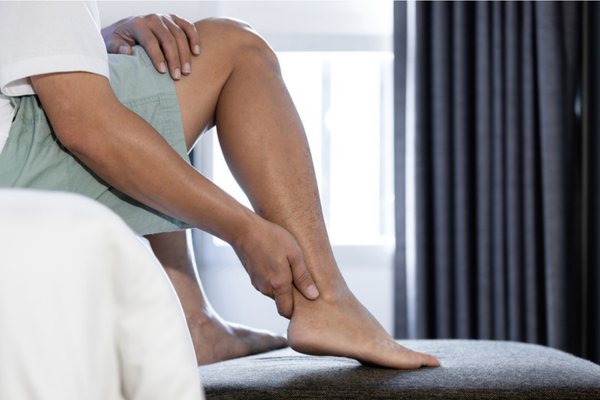
Calf strains, pulls, tweaks, and Achilles tendon issues are far too common in both competitive sports and recreational activities. No matter the severity, they can leave you hobbling, frustrated, and sidelined longer than you'd like.
In this article series, I’ll walk you through the why, the what, and the how of calf and Achilles injuries — including basic anatomy, common injury patterns, and actionable strategies to help you recover and stay moving.
Basic Anatomy: What Even Is the Calf?
When we talk about the “calf,” we’re really referring to two separate muscles:
Gastrocnemius (outer, more superficial)
Soleus (deeper and lower)
Both are part of the posterior lower leg and contribute to plantarflexion — that “gas pedal” motion we use to walk, run, jump, and push off the ground.
Gastroc is active when the knee is straight — think jumping or sprinting.
Soleus kicks in when the knee is bent — like during lunging or mid-stance in running.
These two muscles blend into one thick, powerful tendon: the Achilles tendon, which attaches to the heel bone and can tolerate over 1,100 lbs of force when healthy.
We’ll dive deeper into Achilles-specific injuries and rehab in Part 2 of this series.
Calf Injuries: What Is a Strain?
A muscle strain occurs when fibers are stretched too far, too fast, or overloaded unexpectedly. In the calf, this often happens when the ankle is forced into dorsiflexion (toes pulled up) while bearing weight.
There are three common scenarios:
If the knee is straight, the gastroc usually takes the hit.
If the knee is bent, like in a lunge or during acceleration, the soleus is more likely involved.
Fatigue, especially in distance runners, is another common trigger.
Most people describe it as a sudden "twinge" or sharp pain. This is caused by microtearing of muscle fibers, which compromises force production and overall function — temporarily.
Calf Strain Severity:
Grade I
Description: Mild: minor tearing, little strength loss
Symptoms: Mild pain, tenderness, possible swelling
Grade II
Description: Moderate: more tearing and weakness
Symptoms: Moderate/severe pain, bruising, limited motion
Grade III
Description: Severe: full rupture
Symptoms: Severe pain, loss of function, swelling, possible muscle gap; may require surgery
What to Do If You Injure Your Calf
In the early stage, follow the POLICE principle:
Protect: Avoid high-load activity. Respect the injury.
OL (Optimal Loading): Gentle, symptom-guided movement. I use a “traffic light” system:
Green: Symptoms stable — go ahead.
Yellow: Mild increase in discomfort — proceed with caution.
Red: Pain worsening or sharp — stop and rest.
Ice: Within the first 72 hours, helps reduce swelling and pain.
Compression: Light compression sleeves can help circulation. Avoid anything too tight.
Elevation: Helps reduce swelling by supporting blood flow back to the heart.
Early movement is good — but it needs to be gradual, guided, and pain-informed.
Who’s Most at Risk?
A 2017 systematic review (Calf Muscle Strain Injuries in Sport) identified the two biggest predictors:
Increased age
History of previous calf injury
But that doesn’t mean older, experienced athletes are doomed. These studies can’t account for an individual’s preparedness and resilience.
The real question is: Is your body conditioned to handle the forces your sport requires? That’s where prevention and smart training come in.