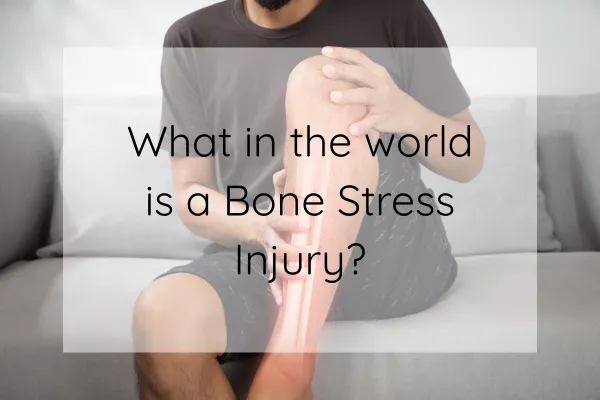
What in the world is a Bone Stress Injury? Bone Stress Response? Stress Fracture?
What in the world is a Bone Stress Injury? Bone Stress Response? Stress Fracture?
Most runners will experience an injury at some point in their running career. Shin splints is a common thing I hear while coaching, which is often an overuse injury impacting the muscles and tendons in the lower leg. However sometimes it is something more - an injury to the bone! The least severe is a bone stress reaction and most significant would be a stress fracture where the bone is actually broken.

A bone stress injury ranges from a stress reaction to a stress fracture:
A bone stress reaction is periostitis (inflammatory reaction of the periosteum of the bone, which is the outermost layer of bone). A stress fracture involves the cortical bone, which is the denser, stronger layer of bone under the periosteum. This layer provides the general structural support. (reference)
Why do Bone Stress Injuries happen?
The continuum of a stress reaction to a fracture is a result of repetitive loading to the bone that is greater than its ability to heal. In plain English, you do more than your body can handle. Often these types of injuries will pop up after a sudden increase in running mileage, or introducing a new plyometrics program. Our bones are constantly breaking down and rebuilding, a stress related injury to the bone happens when the break down is faster than the rebuild. That could be from too much activity, too little rest time, or too little resources for your body to rebuild.
Risk Factors of Bone Stress Injuries (Reference)
There are both controllable and uncontrollable risk factors related to bone stress injuries.
Things like gender (female), anatomical differences (knock kneed, etc), and certain medical conditions are not controllable but do carry an increased risk of bone stress injuries.
Factors like training volume and design, training surfaces, and footwear will also impact risk. Training too much too soon, training on uneven, irregular, or angled surfaces, and improper footwear can increase risk.
Other factors like hormonal imbalances, menstrual disorders, low bone density, poor conditioning and low muscle mass, and nutritional deficits (like calcium and vitamin D) will also increase risk.
Certain drugs also increase risk: smoking cigarettes, steroids, oral contraceptives (things that impact hormones), and antacids.
Diagnosis of Bone Stress Injuries
X-rays can remain normal for up to 4 weeks, so an MRI is often necessary to actually see the damage to the bone (reference).
Treatment of Bone Stress Injuries
The location of the injury will determine how extreme the treatment needs to be. For majority of issues, they are “low risk” (aka in the tibia, fibula, or metatarsals), protected weight bearing and gradual return to activity will generally be the plan of care. If the injury is in a “high risk” area (femoral neck, anterior tibial cortex, and navicular bone - all of which have a greater risk of delayed healing, nonunion, or progression to a complete fracture) may require immobilization or surgery.
How can Physical Therapy help Bone Stress Injuries?
Physical therapists are experts in biomechanics and anatomy, so figuring out why there was excessive stress on the bone is something we can very much help with. Here at Manual Therapy Specialists, we always do a full comprehensive evaluation, looking at strength, range of motion, and coordination. We look at this locally, where the injury is, but also globally, how does your entire body function? Once we figure out why there is extra stress on the bone, we help you redistribute that stress. That usually includes hands on work, a specific exercise program, and education on how to best support your body while it heals.
How do I avoid Bone Stress Injuries?
Follow an intelligent training plan. Don't increase volume of running and jumping super quickly, usually 10% increase per week is a good place to start. Make sure to take rest days (and not a rest day that includes a 10 mile hike!). Lifting is important too, so don't JUST run.
Prioritize getting enough good nutrition. First and foremost, having enough calories to support your activity levels is important. Make sure you are getting all the macronutrients (proteins, carbs, fats) and micronutrients (vitamins and minerals). Working with a professional can be wildly helpful!
Address significant form and symmetry issues. If your running form is "bad," generally your efficiency will be low. That's more energy used for each step you take, and often more stress going through your bones too. Working on form drills can help improve running economy, thus decreasing how much energy you use to run!
Don't ignore or train through pain. Listen to your body, if something is really hurting, take a break and get it checked out! Its not worth it to hurt yourself.